On this page
- What is supply and demand trading?
- What do rally-base-drop and drop-base-rally mean?
- What is an order block?
- What is the difference between order blocks and supply and demand zones?
- Where do they overlap?
- Which is better: supply and demand or order blocks?
- What mistakes do traders make with these zones?
- How our bots use this
- FAQ
- Sources and further reading
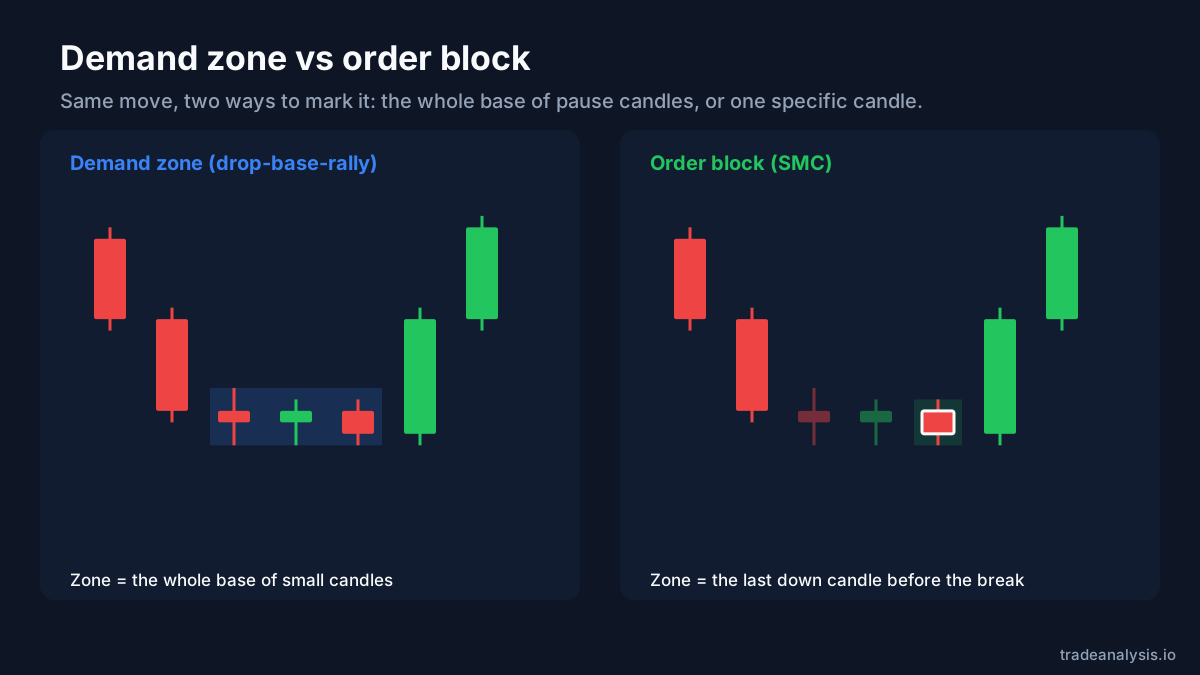
Supply and demand zones and order blocks both mark areas price left quickly and might react to on a return. The difference is construction: a supply or demand zone is usually a base of small candles before a strong departure, while an order block is one candle defined by a liquidity sweep and structure break.
In other words, supply and demand trading and smart money concepts describe similar places on a chart using different rules. This guide explains how each one is drawn, where they overlap, and what to watch out for. As with any chart concept, definitions vary from trader to trader, and neither approach is proven to give an edge.
What is supply and demand trading?
It is a method built around one idea: when price leaves an area fast, there may have been more buyers than sellers there (demand) or more sellers than buyers (supply). Traders mark that area and watch for price to come back to it.
A zone usually has two parts:
- The base: one or a few small-bodied candles where price paused.
- The departure: a strong move away from the base, often a run of large candles in one direction.
The zone is drawn around the base, typically from the highest to the lowest point of the base candles (some traders use bodies only for one edge and wicks for the other).
What do rally-base-drop and drop-base-rally mean?
These names describe the shape of the move into and out of the base. There are four common patterns:
| Pattern | Move into base | Move out of base | Zone type |
|---|---|---|---|
| Rally-base-drop (RBD) | Up | Down | Supply (reversal) |
| Drop-base-drop (DBD) | Down | Down | Supply (continuation) |
| Drop-base-rally (DBR) | Down | Up | Demand (reversal) |
| Rally-base-rally (RBR) | Up | Up | Demand (continuation) |
The direction of the departure decides whether it is supply or demand. Departure down means supply above price; departure up means demand below price.
What is an order block?
In SMC usage, an order block is the last opposite-coloured candle before a strong move that breaks market structure. Before a bullish break that is the last down candle; before a bearish break, the last up candle. Our full guide on how to identify order blocks covers bullish and bearish versions, mitigation and breaker blocks.
The key point for this comparison is that an order block is rarely looked at on its own. SMC traders usually want it to sit inside a sequence:
- Price sweeps liquidity, wicking through an obvious high or low and closing back inside. See what a liquidity sweep is.
- Price then breaks structure in the other direction. See break of structure vs change of character.
- The last opposite candle before that break becomes the order block.
What is the difference between order blocks and supply and demand zones?
| Supply and demand zone | Order block (SMC) | |
|---|---|---|
| What is marked | A base of one or more pause candles | One specific candle |
| How it is chosen | Small candles before a strong departure | Last opposite-coloured candle before a structure break |
| Candle colour rule | Usually none | Must be opposite to the move |
| Liquidity sweep | Not usually required | Commonly required before the move |
| Structure break | Strong departure is enough for many traders | Usually required |
| Typical zone width | Often wider (several candles) | Often narrower (one candle) |
| "Freshness" idea | Fresh vs tested zones | Unmitigated vs mitigated |
| Origin of the terms | Classic price-action trading | ICT / smart money concepts |
The biggest practical difference is the checklist. A supply and demand trader can mark a zone wherever a strong departure left a base. An SMC trader marking an order block usually wants the sweep and the structure break first, which means fewer zones overall.
Where do they overlap?
Quite often they pick out nearly the same area. Picture a drop-base-rally: price falls, pauses for two small candles, then rallies hard through a recent swing high. The last small down candle in the base is also the last opposite-coloured candle before the break. A supply and demand trader marks the base as demand; an SMC trader marks that candle as a bullish order block. The two zones sit on top of each other, with the order block usually a little narrower.
They also share the same core belief: a fast departure leaves something behind that price may respond to later. And both use a "used up" idea. Supply and demand traders talk about fresh versus tested zones; SMC traders talk about unmitigated versus mitigated order blocks.
Which is better: supply and demand or order blocks?
Neither has been shown to be better. They are two vocabularies for marking similar areas, and the right choice is the one you can apply the same way every time.
A few practical differences may matter to you:
- Fewer zones vs more zones. The extra SMC conditions mean fewer order blocks than supply and demand zones on the same chart.
- Narrower vs wider. A single-candle order block gives a tighter area; a multi-candle base gives more room.
- Mechanical vs discretionary. Order block rules (last opposite candle, after a sweep, before a break) are easier to write down as code than "a base before a strong move", which needs a judgement call on what counts as strong.
What mistakes do traders make with these zones?
- Mixing definitions mid-trade. Calling something a demand zone when you want to buy and an order block when that fits better is a sign the rules are not fixed.
- Drawing zones on every pause. Without a meaningful departure or structure break, a zone is just a sideways candle.
- Ignoring tested zones. Both schools treat a zone that has already been revisited as weaker or used.
- Fighting the higher timeframe. A demand zone on a 4-hour chart inside a clear daily downtrend is a different situation from one that agrees with the trend.
- Stops inside the zone. If the zone is the entry area, normal movement inside it can reach a stop placed there.
- Assuming a reaction. A zone is a description of past price movement. It does not predict that price will turn.
How our bots use this
The bots on this site use order blocks, not supply and demand zones. All four run the same fixed SMC rules as code; no AI model and no news decides buy, sell or hold. The full rules are on the methodology page.
A BUY or SELL needs, in order: a liquidity sweep of a watched level (a candle wicks through it and closes back inside); a structure shift, where within 12 candles price closes beyond the last swing point in the opposite direction to the sweep; a return to the order block, which is the last opposite-coloured candle before that shift, with the signal firing on the first candle that comes back into it; and a higher-timeframe trend that agrees (last closed higher-timeframe candle above its 50-period EMA for a buy, below for a sell). The Scalper and Basic Day bots also have a session filter. Otherwise the answer is HOLD.
The two longer-term bots apply this as follows:
- The Advance Day bot uses a 4-hour chart with a daily trend filter and watches previous-day and previous-week levels, in any session.
- The Swing bot uses a daily chart with a weekly trend filter and watches previous-week and previous-month levels, in any session.
The whole order block candle is shown as the entry zone, and the stop sits just beyond the sweep wick plus 0.1× ATR. Targets are 1× and 2× the risk, and if the stop is further away than the second target, the signal warns you to size down; how to calculate lot size shows the arithmetic. Only closed candles are used, so the same candles always give the same answer. The site publishes no win rates or profit figures.
FAQ
Is an order block a type of demand or supply zone?
You can think of it that way. A bullish order block often sits inside what a supply and demand trader would call a demand zone, but it is chosen with stricter rules and is usually narrower.
What is a fresh supply or demand zone?
A fresh zone is one price has not returned to since the departure. Once price comes back into it, most traders call it tested and treat it as weaker. SMC traders use "unmitigated" and "mitigated" for the same idea.
Do I need a liquidity sweep for a supply and demand zone?
Not in classic supply and demand trading. The sweep requirement comes from smart money concepts, where it is commonly part of what makes an order block count.
Free tools for this: before trading a zone, check the trade's reward to risk with the risk reward calculator.
Sources and further reading
- Support and Resistance, StockCharts ChartSchool: the classic basis for marking zones where buying or selling previously overwhelmed the other side.
- The Wyckoff Method: A Tutorial, StockCharts ChartSchool: supply and demand as Wyckoff described them.
- Order Block: Definition and Indicators, LuxAlgo Library: the smart money concepts definition used for comparison in this post.
This is educational content, not financial advice.
Written by
Pranav, Founder of TradeAnalysis
After five years in trading and research, Pranav built TradeAnalysis to bring multi-angle analysis to individual traders. About us
Educational content, not financial advice. Trading involves substantial risk of loss. Full risk disclaimer.