On this page
A break of structure (BOS) is when price breaks a swing point in the direction of the existing trend, suggesting the trend is continuing. A change of character (CHoCH) is the first break of a swing point against the trend, suggesting it may be ending. Both are read from swing highs and lows, usually on a candle close.
These two terms come from smart money concepts (SMC), which our smart money concepts overview covers in full. Neither one predicts what price does next. They are labels for what price has already done, and traders draw them slightly differently. This guide sets out the common definitions so you can read them consistently.
What are swing highs and swing lows?
Everything in market structure starts with swing points.
- A swing high is a candle whose high is higher than the highs of the candles around it.
- A swing low is a candle whose low is lower than the lows of the candles around it.
How many candles count as "around it" is a choice. Some traders use one candle on each side, some use two, some use five. Fewer candles give you more swing points and more noise. More candles give you fewer, more significant points. There is no correct number, but you should pick one and stick to it.
From swing points you get trend:
- Uptrend: higher highs and higher lows.
- Downtrend: lower highs and lower lows.
- Range: neither pattern is clear.
What is a break of structure (BOS)?
A break of structure is a continuation signal. In an uptrend, price closes above the most recent swing high. In a downtrend, price closes below the most recent swing low. The trend made a new extreme, which is what a trend is supposed to do.
Example: gold is making higher highs and higher lows on the 1-hour chart. The last swing high is at a certain price. A candle closes above it. That is a bullish BOS. The trend is intact.
A BOS on its own is not a reason to enter. It just confirms the structure you already thought was there. The latest structure breaks on gold, from the 15-minute to the daily chart, are listed on our gold analysis today page.
What is a change of character (CHoCH)?
A change of character is the first sign that a trend might be turning. In an uptrend, it is the first close below the most recent swing low that led to a higher high. In a downtrend, it is the first close above the most recent swing high that led to a lower low.
Example: Bitcoin has been making lower highs and lower lows on the 4-hour chart. Then a candle closes above the last lower high. That is a bullish CHoCH. The downtrend pattern is broken for the first time.
A CHoCH does not mean the trend has reversed. It means the old pattern failed once. Many CHoCHs are followed by the original trend resuming.
BOS vs CHoCH: the key differences
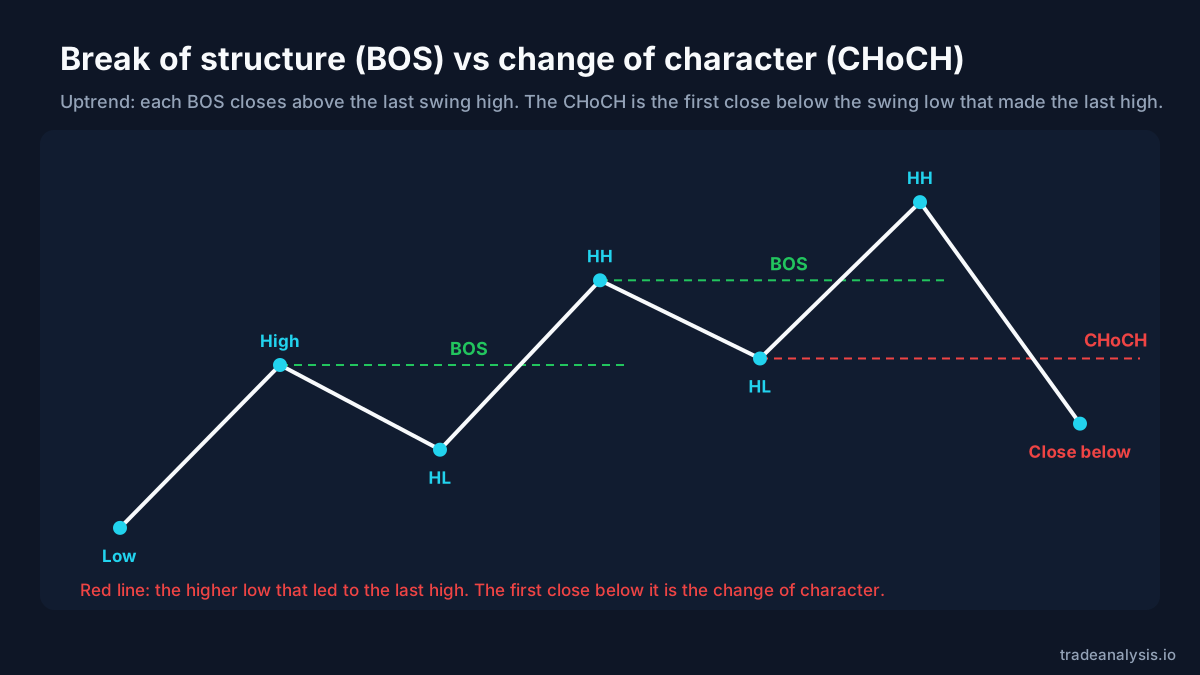
| Break of structure (BOS) | Change of character (CHoCH) | |
|---|---|---|
| Direction | With the current trend | Against the current trend |
| What it breaks in an uptrend | The last swing high | The last swing low |
| What it breaks in a downtrend | The last swing low | The last swing high |
| What it suggests | The trend is continuing | The trend may be ending |
| How often it appears | Many times in a trend | Once, at the first break against it |
| Common use in SMC | Confirms bias, marks new swing points | Starts looking for a possible turn |
The easiest way to remember CHoCH vs BOS: a BOS agrees with the trend, a CHoCH disagrees with it for the first time. In BOS trading, each new break simply confirms the bias and marks the next swing point to manage risk from.
What is a market structure shift (MSS)?
"Market structure shift" is a third term you will see. In most usage it means much the same as a CHoCH: a break of structure against the prior direction. Some traders reserve MSS for a CHoCH that happens right after a liquidity sweep, driven by a strong, fast move. Others use the terms interchangeably.
MSS is the term our bots use, and we define it precisely below so there is no ambiguity.
Should you use the candle close or the wick?
This is one of the biggest sources of disagreement.
- Wick break: any trade beyond the swing point counts. You get earlier signals, but many of them are just a quick poke that reverses.
- Close break: the candle must close beyond the swing point. You get fewer, later signals, but each one is clearer and can be checked after the fact.
A common approach is to use closes for BOS and CHoCH, and treats a wick through a level followed by a close back inside as a liquidity sweep instead. That split keeps the two ideas separate: wicks for sweeps, closes for structure.
Common mistakes
- Mixing timeframes. A CHoCH on the 15-minute chart can be a normal pullback on the 4-hour chart. Decide which timeframe defines your trend.
- Changing your swing definition mid-trade. If you redraw swing points to fit the story, the labels mean nothing.
- Treating every CHoCH as a reversal. It is the first break, not proof of a turn.
- Ignoring ranges. In a sideways market, price breaks swing points in both directions constantly. BOS and CHoCH labels are much less useful there.
How our bots use this
All four TradeAnalysis bots run the same fixed SMC rules as code. No AI model and no news decides buy, sell or hold. A structure shift is step two of those rules, and it only counts if it comes straight after a liquidity sweep.
| Bot | Setup chart | Trend filter | Levels watched | Sessions |
|---|---|---|---|---|
| Scalper | 15-minute | 4-hour | Previous day, Asian session | London and New York only |
| Basic Day | 1-hour | 4-hour | Previous day, Asian session | London and New York only |
| Advance Day | 4-hour | Daily | Previous day, previous week | Any |
| Swing | Daily | Weekly | Previous week, previous month | Any |
A BUY or SELL needs all of these, in order:
- A liquidity sweep: a candle wicks through one of those levels and closes back inside it.
- A structure shift: within 12 candles, price closes beyond the last swing point in the opposite direction to the sweep. A sweep below a low needs a close above the last swing high; a sweep above a high needs a close below the last swing low. Wicks do not count.
- A return to the order block: the order block is the last opposite-coloured candle before that shift, and the signal fires on the first candle that comes back into it.
- The trend agrees: the last closed higher-timeframe candle is above its 50-period EMA for a buy, below it for a sell.
- The session fits: Scalper and Basic Day only signal in London (07:00–10:00 UTC, 12:30–15:30 IST) and New York (12:00–16:00 UTC, 17:30–21:30 IST). In New York time that is 03:00–06:00 and 08:00–12:00 during US daylight time, an hour earlier in winter. Gold may also signal outside those windows, but capped at Medium confidence and labelled.
If any step is missing, the answer is HOLD. The stop sits just beyond the sweep wick plus 0.1× ATR. Gold on Scalper and Basic Day uses targets of 100 pips ($10) and 200 pips ($20) from the zone edge; everything else uses 1× and 2× the risk. Only closed candles are used, so the same candles always give the same answer. Full details are on the methodology page. We do not publish performance figures for the bots.
Note that the bots do not separately label BOS and CHoCH. They only look for the one shift that matters to the rule: a close against the direction of the sweep.
FAQ
Is CHoCH the same as a market structure shift?
Mostly, yes. Many traders use the two terms interchangeably, while some reserve MSS for a CHoCH that follows a liquidity sweep with a strong move. Check how a particular course or tool defines it before comparing notes.
Which comes first, BOS or CHoCH?
In a typical sequence, a trend shows several BOS in its own direction, then a CHoCH marks the first break against it. If a new trend develops, it then starts printing its own BOS. Many CHoCHs never lead to a new trend at all.
Do I need a candle close for a break of structure?
Most SMC traders say yes, because a close is easier to define and check. A wick through a swing point that closes back inside is usually treated as a liquidity sweep, not a break of structure.
What timeframe should I use for market structure?
Use one timeframe to define the trend and a lower one to look for setups, and keep that pairing fixed. Our Basic Day bot, for example, pairs a 1-hour setup chart with a 4-hour trend filter, and the Swing bot pairs daily with weekly.
Sources and further reading
- Dow Theory, StockCharts ChartSchool: the older idea behind reading trends from higher highs and higher lows, which market structure labels build on.
- Support and Resistance, StockCharts ChartSchool: why prior swing highs and lows act as reference levels.
This is educational content, not financial advice.
Written by
Pranav, Founder of TradeAnalysis
After five years in trading and research, Pranav built TradeAnalysis to bring multi-angle analysis to individual traders. About us
Educational content, not financial advice. Trading involves substantial risk of loss. Full risk disclaimer.