Free tool · trade planning
Risk Reward Ratio Calculator
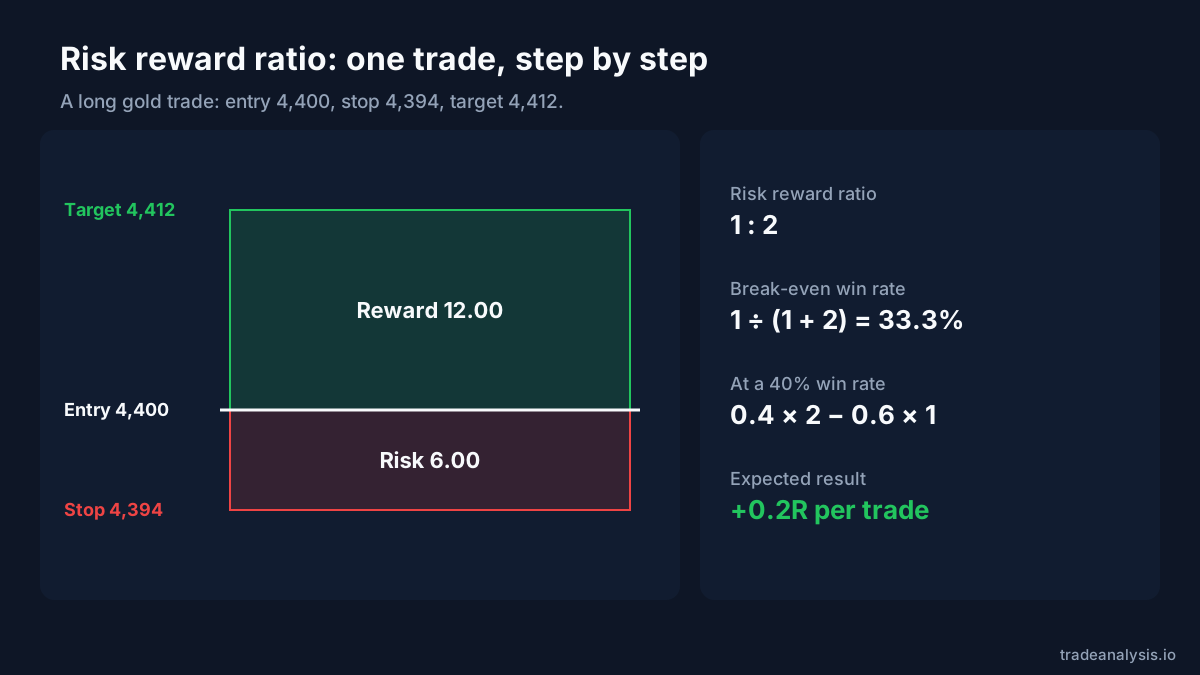
The risk reward ratio compares what a trade can make with what it can lose: the distance from entry to target divided by the distance from entry to stop. At 1:2 a trade risks 1 to make 2, so it only needs to win more than a third of the time (33.3%) to break even before costs.
Enter your entry, stop and target to see the risk to reward ratio, the win rate you need to break even, and what the trade is worth per attempt at your win rate. Works for gold, forex, stocks and crypto.
Risk reward ratio
1 : 2.00
- Risk (entry to stop)
- 6.00
- Reward (entry to target)
- 12.00+2.00R if it hits
- Win rate needed to break even
- 33.3%before spread and commission
- Expectancy at a 40% win rate
- +0.20Raverage gain per trade, in units of risk
To turn the stop into a position size, use the gold lot size calculator.
Risk reward ratio and break-even win rate
The win rate a strategy needs just to break even (1 ÷ (1 + ratio)), and the expectancy at a few win rates. Costs ignored.
| Ratio | Break-even win rate | At 30% wins | At 40% wins | At 50% wins | At 60% wins |
|---|---|---|---|---|---|
| 1 : 0.5 | 66.7% | −0.55R | −0.40R | −0.25R | −0.10R |
| 1 : 1 | 50.0% | −0.40R | −0.20R | +0.00R | +0.20R |
| 1 : 1.5 | 40.0% | −0.25R | +0.00R | +0.25R | +0.50R |
| 1 : 2 | 33.3% | −0.10R | +0.20R | +0.50R | +0.80R |
| 1 : 3 | 25.0% | +0.20R | +0.60R | +1.00R | +1.40R |
| 1 : 4 | 20.0% | +0.50R | +1.00R | +1.50R | +2.00R |
How to use the risk reward ratio
The ratio on its own doesn't tell you whether a trade is good. It tells you how often the trade has to work. A 1:2 trade only needs to win a third of the time to break even, but if the setup behind it wins a quarter of the time, it still loses money. Pair the ratio with an honest win rate from your own record.
Our bots set two targets on every setup: TP1 at one times the risk and TP2 at two times the risk (gold on the Scalper and Basic Day uses fixed $10 and $20 moves instead). At those ratios the break-even win rates are 50% and 33.3%. The full rules are on the methodology page, and the win rate calculator shows what your own record adds up to.
More free trading tools
Risk reward calculator FAQ
How do you calculate the risk reward ratio?
What win rate do I need for a 1:2 risk reward?
Is a higher risk reward ratio always better?
What is a good risk to reward ratio?
What does R mean in trading?
Educational, not financial advice. Trading involves risk of loss.