Free fib calculator · retracements and extensions
Fibonacci Retracement Calculator
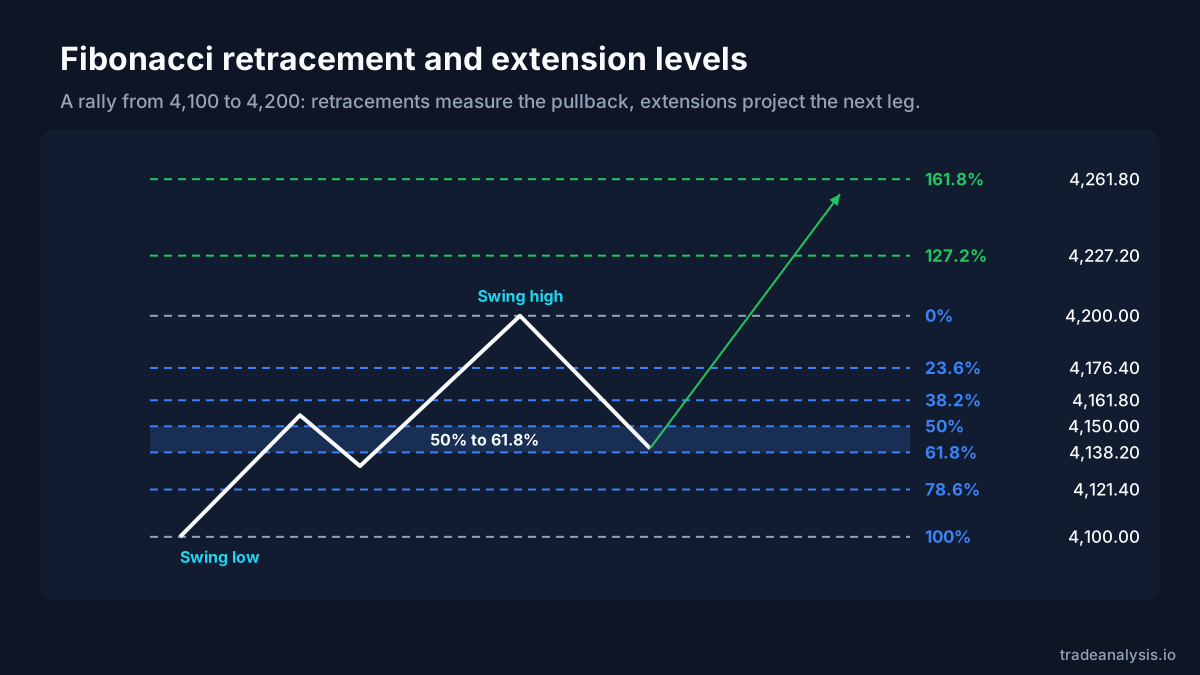
Fibonacci retracement levels mark how far price may pull back inside a swing: the swing's range multiplied by 23.6%, 38.2%, 50%, 61.8% and 78.6%, measured back from the end of the move. Fibonacci extensions (127.2% to 261.8%) project beyond the swing and are used as targets when the move continues.
Enter a swing high and low to get the Fibonacci retracement levels and extension targets; it works as a Fibonacci extension calculator too. Gold's, EUR/USD's and GBP/USD's latest daily or weekly range is filled in to start with. Free, no sign-up, updates as you type.
Fibonacci levels for a move down of 144.03
| Level | Ratio | Price |
|---|---|---|
| Extension | 261.8% | 3,840.40 |
| Extension | 200% | 3,929.41 |
| Extension | 161.8% | 3,984.43 |
| Extension | 141.4% | 4,013.81 |
| Extension | 127.2% | 4,034.26 |
| Swing low | 100% | 4,073.44 |
| Retracement | 23.6% | 4,107.43 |
| Retracement | 38.2% | 4,128.46 |
| Retracement | 50% | 4,145.46 |
| Retracement | 61.8% | 4,162.45 |
| Retracement | 78.6% | 4,186.65 |
| Swing high | 0% | 4,217.47 |
Extensions sit below the low and are measured from the start of the swing. Reference levels, not predictions.
How to calculate Fibonacci retracements
After an up move: level = swing high − (swing high − swing low) × ratio
After a down move the levels are measured up from the swing low instead.
Using it as a Fibonacci extension calculator
Extensions use the same range: for an up move, extension = swing low + range × ratio, so the 161.8% extension sits 61.8% of the range above the high. Traders use 127.2% and 161.8% as first targets when a move continues past its previous swing.
Worked example: gold rallies from 4,100 to 4,200. The range is 100, so the 38.2% retracement is 4,200 − 38.2 = 4,161.80, the 50% is 4,150.00 and the 61.8% is 4,138.20. The 161.8% extension is 4,100 + 161.8 = 4,261.80.
Fibonacci levels and order blocks
Smart money traders often check whether an order block lines up with the 50% or 61.8% retracement of the move that created it, sometimes called the discount or premium half of the range. Our bots don't use Fibonacci at all: they wait for price to return to the order block after a liquidity sweep and a structure shift. The areas they're watching on gold right now are on the gold analysis page.
More free trading tools
Fibonacci calculator FAQ
How do you calculate Fibonacci retracement levels?
Which Fibonacci levels matter most?
Which swing high and low should I use?
What is the difference between a retracement and an extension?
Educational, not financial advice. Trading involves risk of loss.