On this page
Smart money concepts (SMC), sometimes called smart money trading, is a price-action framework that tries to read charts from the point of view of large traders. It focuses on where stop orders cluster (liquidity), how swing highs and lows break (market structure), and the zones price left behind before a strong move (order blocks and fair value gaps). It is discretionary, and definitions vary.
This page is an overview. Each building block has its own guide, linked below. The aim is to explain what SMC traders look at, not to claim it works. SMC has no agreed rulebook and no strong body of published evidence behind it, and you should read it with that in mind.
What is SMC trading?
The starting idea behind SMC trading is simple. Banks, funds and other large participants move enough money that they cannot fill their orders at a single price without moving the market. To buy a lot, they need a lot of sellers. SMC argues that this need leaves visible traces on a chart: runs through obvious highs and lows, sharp one-way moves, and gaps where price moved too fast to trade evenly.
You cannot check from price alone whether a pattern reflects what institutions did. SMC is best treated as a vocabulary for describing price action.
Where does smart money concepts come from?
Most of the current SMC vocabulary was popularised online by Michael Huddleston, who teaches under the name Inner Circle Trader, or ICT. Trading-software firm ATAS, which says it is not affiliated with him, describes ICT as the trader behind the Smart Money Concept. Many of the terms in this guide, such as fair value gap and order block, are used heavily in ICT teaching, and the label "SMC" is now applied broadly to many traders' variations on those ideas.
The underlying thinking is older. Richard Wyckoff, a trader and publisher in the early 1900s, built a method around large operators accumulating and distributing positions inside ranges. His "spring" and "upthrust" are brief moves beyond a range that snap back, which closely resemble what SMC calls a liquidity sweep. A LuxAlgo summary of the Wyckoff method notes that its labels are discretionary and easier to apply in hindsight, and that no broadly accepted statistical study shows its schematics predict outcomes. The same caution applies to SMC.
The core building blocks
| Concept | What it is | Guide |
|---|---|---|
| Liquidity | Clusters of stop and pending orders above highs and below lows | What is a liquidity sweep? |
| Market structure | Swing highs and lows; breaks with or against the trend | BOS vs CHoCH |
| Order blocks | The last opposite-coloured candle before a strong move | How to identify order blocks |
| Fair value gaps | A three-candle gap left by a fast move | What is a fair value gap? |
| Premium and discount | Whether price is in the upper or lower half of a range | Covered below |
| Sessions and killzones | The hours when the main markets are active | London and New York session times |
SMC also overlaps with older supply and demand trading. The two are similar but not identical, which we compare in supply and demand zones vs order blocks.
Liquidity
Stops tend to sit just beyond obvious levels: the previous day's high and low, the previous week's, the Asian session range, and equal highs or lows. SMC traders call orders above highs buy-side liquidity and below lows sell-side liquidity. A liquidity sweep is a wick through one of those levels that closes back inside.
Market structure
Trends are read from swing points. A break of structure (BOS) is a break in the trend's own direction. A change of character (CHoCH), also called a market structure shift (MSS), is the first break against it.
Order blocks
An order block is usually defined as the last down candle before a strong move up, or the last up candle before a strong move down. SMC traders treat it as a zone price may return to.
Fair value gaps
A fair value gap is the space between the first and third candle of a fast three-candle move, where the middle candle's range was not overlapped. Traders watch whether price comes back to fill it.
Premium and discount
Take a swing range and split it in half. The upper half is "premium" and the lower half is "discount". The idea is to look for buys in discount and sells in premium, rather than buying after price has already run up.
Sessions and killzones
Many SMC traders only look for setups during the busiest hours, especially the London and New York sessions. "Killzone" is an ICT term for these windows. Exact hours differ from one source to the next, so always check which clock a teacher is using and whether it adjusts for daylight saving.
How the pieces fit together
On their own, each concept is just a label. SMC traders usually chain them into a sequence:
- Context. Decide the trend on a higher timeframe.
- Liquidity. Wait for price to sweep an obvious high or low.
- Structure. Wait for a structure shift in the opposite direction.
- Entry zone. Mark the order block or fair value gap left by that shift.
- Return. Wait for price to come back into the zone.
- Risk. Place a stop beyond the sweep and set targets.
Every step involves choices, which is why two SMC traders can read the same chart differently.
What are the limits of SMC?
- It is discretionary. Most SMC teaching leaves room for judgement, which makes results hard to test and easy to rationalise.
- Definitions vary. Order block, killzone and MSS mean slightly different things to different teachers.
- It is not academically validated. We are not aware of peer-reviewed research showing that SMC concepts give traders an edge.
- Hindsight is generous. On a past chart, every big move has a sweep and an order block somewhere behind it.
- The institutional story is unverifiable. You cannot see who placed the orders that formed a candle.
Treat the concepts as a hypothesis, not as a fact about how markets work.
To see the labels on a live chart, our gold analysis today page shows the sweeps, structure breaks and order blocks the bots have found on XAU/USD in the current session.
How our bots use smart money concepts
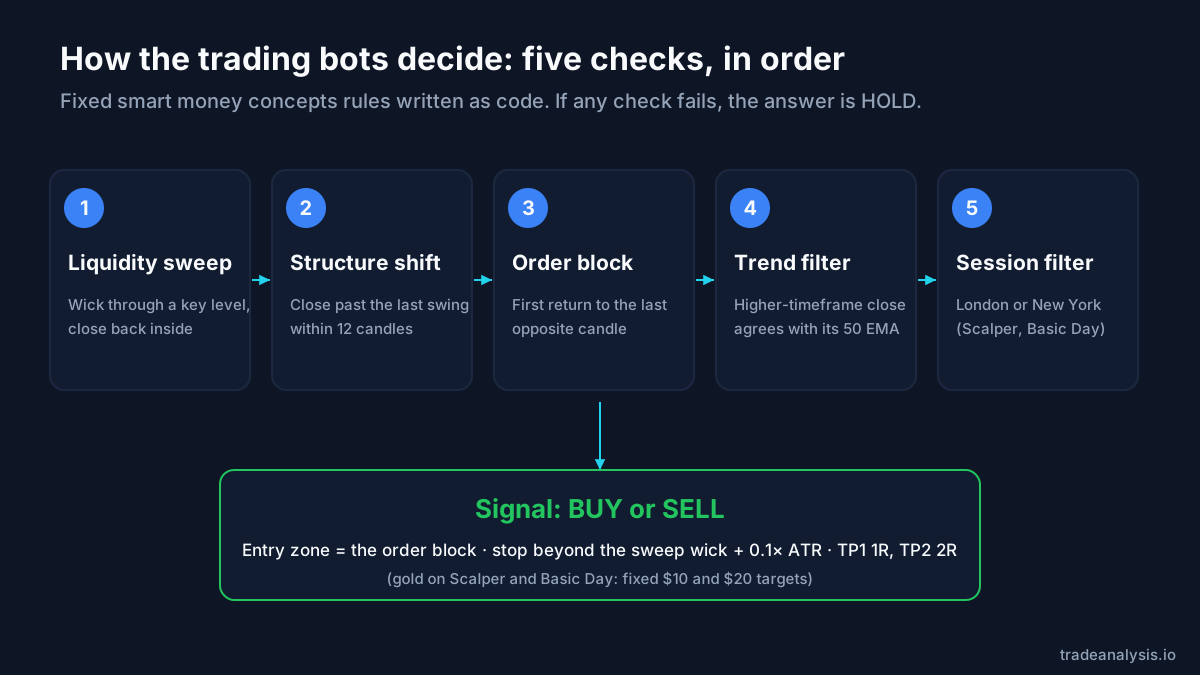
Our four bots turn one narrow version of SMC into fixed code. No AI model and no news decides buy, sell or hold, and nothing is left to judgement.
| Bot | Setup chart | Trend filter | Levels watched | Sessions |
|---|---|---|---|---|
| Scalper | 15-minute | 4-hour | Previous day, Asian session | London and New York only |
| Basic Day | 1-hour | 4-hour | Previous day, Asian session | London and New York only |
| Advance Day | 4-hour | Daily | Previous day, previous week | Any |
| Swing | Daily | Weekly | Previous week, previous month | Any |
A BUY or SELL needs, in order: (1) a liquidity sweep, where a candle wicks through one of those levels and closes back inside it; (2) a structure shift, where within 12 candles price closes beyond the last swing point in the opposite direction to the sweep; (3) a return to the order block, which is the last opposite-coloured candle before that shift, with the signal firing on the first candle that comes back into it; (4) trend agreement, meaning the last closed higher-timeframe candle is above its 50-period EMA for a buy and below it for a sell; and (5) the right session. Scalper and Basic Day only signal in London (07:00–10:00 UTC, 12:30–15:30 IST) and New York (12:00–16:00 UTC, 17:30–21:30 IST). In New York time that is 03:00–06:00 and 08:00–12:00 during US daylight time, and an hour earlier in winter. Gold may also signal outside those windows, capped at Medium confidence and labelled.
Otherwise the answer is HOLD. The bots do not use fair value gaps or premium and discount. Stops sit just beyond the sweep wick plus 0.1× ATR, with two targets. Only closed candles are used, so the same candles always give the same answer. The full rules are on the methodology page, and we do not publish performance figures for the bots.
FAQ
Is smart money concepts the same as ICT?
They overlap heavily. Much of the SMC vocabulary was popularised through ICT teaching, but "SMC" is now used as a broad label for many traders' versions of those ideas, and they do not all agree on definitions.
Does smart money concepts work?
There is no solid evidence that it gives traders an edge, and its discretionary nature makes it hard to test. It is better treated as a way of describing price action than as a proven method.
Is SMC good for beginners?
The vocabulary is easy to learn, but applying it consistently is hard because so much depends on judgement. Beginners often benefit from fixing their definitions in writing, such as which levels count and whether a close is required, before using any of it.
This is educational content, not financial advice.
Written by
Pranav, Founder of TradeAnalysis
After five years in trading and research, Pranav built TradeAnalysis to bring multi-angle analysis to individual traders. About us
Educational content, not financial advice. Trading involves substantial risk of loss. Full risk disclaimer.