On this page
A fair value gap (FVG) is a three-candle pattern where a fast move leaves a range only one candle traded through. In a bullish FVG, the high of candle 1 is below the low of candle 3, and the space between them is the gap. A bearish FVG is the mirror: candle 1's low is above candle 3's high.
Fair value gaps, and the FVG trading built around them, are part of smart money concepts (SMC), the framework covered in our smart money concepts overview. This guide explains how to draw one, what traders mean when they say a gap was "filled" or "mitigated", and where people go wrong. It does not claim FVGs predict anything. They describe how price moved, and traders disagree on how much that tells you.
How do you identify a fair value gap?
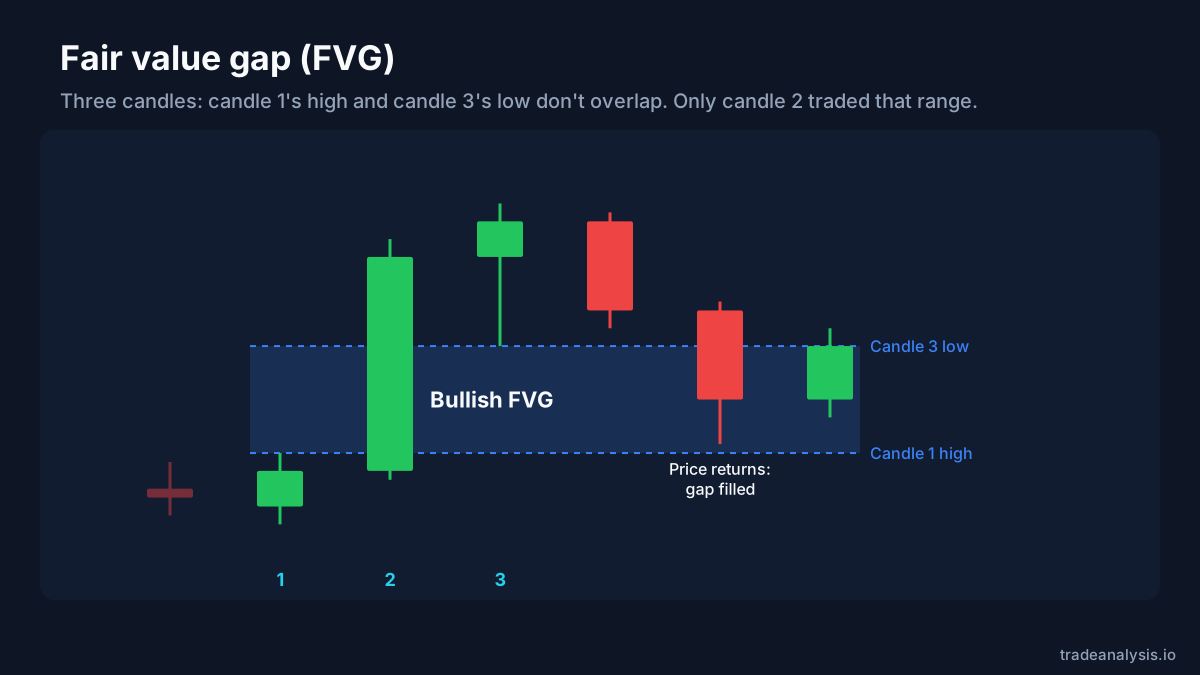
You need three consecutive candles. Look at the first and the third, and ignore the middle one's body for a moment.
Bullish fair value gap
- Candle 2 is a strong up candle.
- The high of candle 1 is below the low of candle 3.
- The gap runs from candle 1's high up to candle 3's low.
Bearish fair value gap
- Candle 2 is a strong down candle.
- The low of candle 1 is above the high of candle 3.
- The gap runs from candle 3's high up to candle 1's low.
| Bullish FVG | Bearish FVG | |
|---|---|---|
| Middle candle | Strong up move | Strong down move |
| Condition | Candle 1 high < candle 3 low | Candle 1 low > candle 3 high |
| Gap top | Candle 3 low | Candle 1 low |
| Gap bottom | Candle 1 high | Candle 3 high |
| How SMC traders view it | A possible support zone below price | A possible resistance zone above price |
If candle 1 and candle 3 overlap at all, there is no fair value gap by this definition. This is different from a classic price gap between one close and the next open, which is more common in stocks between one session and the next.
Why do fair value gaps form?
A fair value gap forms when price moves quickly in one direction and the middle candle trades through a range without much back-and-forth. Common causes are:
- a news release or data print,
- a session open, when volume picks up quickly,
- a run of stop orders after a level breaks,
- a large order hitting a thin market.
SMC traders describe the gap as an "imbalance", meaning one side was far more aggressive than the other. That interpretation is a story about the move, not something you can confirm from a chart.
What does "filled" or "mitigated" mean?
These two words describe price coming back into the gap later.
- Mitigated usually means price has traded back into the gap, at least partly.
- Filled usually means price has traded through the whole gap, from one edge to the other.
Usage is not consistent. Some traders say a gap is mitigated once price touches it, others once it reaches the midpoint. Pick a definition and write it down, or you will end up grading the same chart differently on different days.
Many gaps are never revisited, and many are filled straight away. Neither outcome is a rule.
How does FVG trading work?
FVG trading usually takes one of three forms.
As an entry zone. After a strong move up leaves a bullish FVG, some traders wait for price to pull back into the gap and look for a buy there, with a stop below the gap or below the move's origin.
As a target. An unfilled gap above or below price is sometimes used as a place price may travel back to, so it becomes a target for an existing trade.
Combined with structure. Most SMC traders only pay attention to a gap that formed during a meaningful move, such as the move that caused a break of structure or change of character. A gap in the middle of a sideways range carries much less weight in their reading.
What is an inverse fair value gap (IFVG)?
An inverse fair value gap is a fair value gap that price closed straight through instead of reacting to. Traders who use the idea then flip the gap's role: a bullish FVG that fails becomes a possible bearish area if price comes back up into it, and a failed bearish FVG becomes a possible bullish one. It is the FVG version of a breaker block, one more label you will meet in fair value gap trading, and like most SMC labels it describes what price did rather than proving the flipped zone will hold.
Common mistakes with FVGs
- Treating every gap as a setup. On a 1-minute or 5-minute chart, fair value gaps appear constantly. Most of them are just normal volatility.
- Ignoring timeframe. A gap on a 15-minute chart may be invisible on a 4-hour chart, and vice versa. Decide which timeframe matters before you mark anything.
- Ignoring direction. Buying into a bullish FVG while the higher-timeframe trend is down is a very different trade from buying it in an uptrend.
- Drawing gaps after the fact. On a past chart, the gaps that "worked" are easy to see. In real time you do not know which one price will respect.
- Using open candles. Until candle 3 closes, its low or high can still change, and the gap can disappear.
Fair value gaps vs order blocks
Fair value gaps and order blocks often appear in the same move, which is why they get confused.
| Fair value gap | Order block | |
|---|---|---|
| Built from | Three candles | One candle |
| Location | Inside the fast move | Just before the fast move |
| Definition | Gap between candle 1 and candle 3 | Last opposite-coloured candle before the move |
| Always present? | Only if the move was fast enough to leave a gap | One can be marked before any strong move |
When price makes a strong move up, the last down candle before it is the order block, and the move itself may leave a bullish FVG just above it. Price coming back down would usually reach the FVG first and the order block second. Our guide on how to identify order blocks covers the order block side in detail.
How our bots use this
Our bots do not trade fair value gaps. They use order blocks instead, and an FVG plays no part in any decision.
All four TradeAnalysis bots run the same fixed SMC rules as code, and no AI model or news decides buy, sell or hold. A BUY or SELL needs, in order:
- A liquidity sweep: a candle wicks through a watched level and closes back inside it. The Scalper watches the previous day and Asian session levels on a 15-minute chart; the Advance Day bot watches the previous day and previous week on a 4-hour chart.
- A structure shift: within 12 candles, price closes beyond the last swing point in the opposite direction to the sweep.
- A return to the order block: the order block is the last opposite-coloured candle before that shift, and the signal fires on the first candle that comes back into it.
- The trend agrees: the last closed higher-timeframe candle is above its 50-period EMA for a buy, below it for a sell (4-hour for the Scalper, daily for Advance Day).
- The session fits: the Scalper only signals in London (07:00–10:00 UTC, 12:30–15:30 IST) and New York (12:00–16:00 UTC, 17:30–21:30 IST). In New York time that is 03:00–06:00 and 08:00–12:00 during US daylight time, an hour earlier in winter. Gold may also signal outside those windows, capped at Medium confidence and labelled. Advance Day runs in any session.
Otherwise the answer is HOLD. The stop sits just beyond the sweep wick plus 0.1× ATR. Gold on the Scalper uses targets of 100 pips ($10) and 200 pips ($20) from the zone edge; other symbols use 1× and 2× the risk. Only closed candles are used, so the same candles always give the same answer.
So if the structure shift leaves a fair value gap, the bots ignore it and wait for price to reach the order block behind it. If price turns around inside the gap and never reaches the order block, there is no signal. See the methodology page for the full rules. We do not publish performance figures for the bots.
FAQ
What is FVG in trading?
FVG stands for fair value gap. It is a three-candle pattern where the first and third candles do not overlap, leaving a gap that only the middle candle traded through.
Is a fair value gap the same as an imbalance?
Most SMC traders use the two terms almost interchangeably. Some use "imbalance" more loosely for any fast one-sided move, and keep "fair value gap" for the strict three-candle definition.
Do fair value gaps always get filled?
No. Some are filled quickly, some partly, and some are never revisited. Treating an unfilled gap as something price must return to is one of the most common mistakes.
What timeframe is best for fair value gaps?
There is no best one. Lower timeframes show many small gaps, higher timeframes show fewer and larger ones. Whichever you use, keep it consistent with the timeframe you use to judge the trend.
Sources and further reading
- Fair Value Gap: Definition and Indicators, LuxAlgo Library: the three-candle definition and how charting tools detect gaps.
- Smart Money Concepts (SMC) Explained: Strategy, Order Blocks and ICT Guide, ATAS: background on the ICT teaching where the fair value gap term comes from.
This is educational content, not financial advice.
Written by
Pranav, Founder of TradeAnalysis
After five years in trading and research, Pranav built TradeAnalysis to bring multi-angle analysis to individual traders. About us
Educational content, not financial advice. Trading involves substantial risk of loss. Full risk disclaimer.