AI macro report: the complete guide
By Pranav, founder of TradeAnalysis · Last updated
This workflow is an AI macroeconomic impact report for your portfolio. Name the economic concern on your mind (rate cuts, rising rates, inflation, a recession, a credit event, the dollar, oil or a market sell-off), optionally with your holdings and time horizon. It checks live US economic data to see whether that concern is actually happening, then shows how it usually flows through to markets, how your holdings line up against it, and what to watch next.
It gives macro context around a decision. It is not a trade signal on a single symbol.
What the AI macro report does
Macro news arrives constantly: a central bank decision, an inflation print, a jobs report, a sector-wide shock. The hard part is translating it into "what does this mean for what I own?" The workflow does that translation:
- It maps how the concern you name typically affects markets.
- It identifies the sectors most sensitive to it, and how your holdings line up against them.
- It shows the live economic data for that concern from FRED (the Federal Reserve Bank of St. Louis), each figure with its date, and says whether the concern is happening now.
- It sets out three scenarios for your time horizon.
- It gives positioning and sector-rotation considerations, scoped to your portfolio and your concern.
Because the guidance is scoped to the concern, a different worry produces a different read on the same portfolio. Rising rates and a credit event hit different parts of a portfolio, and the report reflects that.
It suits investors worried about one economic risk, such as rates, inflation or a recession, and what it means for what they hold. Long-term investors use it to understand their macro exposure without trading on headlines, including before a central bank meeting or a key inflation release.
What you give it
- The concern: the macro risk you want analysed.
- Your holdings as ticker and weight pairs (optional).
- Time horizon (optional, one year if you leave it out).
Portfolio: AAPL 40% MSFT 60%, Concern: rising rates, Horizon: 1 year
Or just ask: "How would rate cuts affect gold?" Holdings without a concern work too: it ranks which macro risks would hurt that mix most.
What you get back
- A bottom line: is the concern happening, and what it usually means for you.
- Live economic data for that concern, each figure dated.
- Your portfolio's exposure, holding by holding.
- Three scenarios for your horizon.
- Sectors that usually win and lose from it.
- Ideas worth considering and what to watch next, including the next CPI, jobs or GDP release date.
Example report
A real, unedited response, captured 11 Nov 2026. Prices have moved since, so run it yourself for a current read.
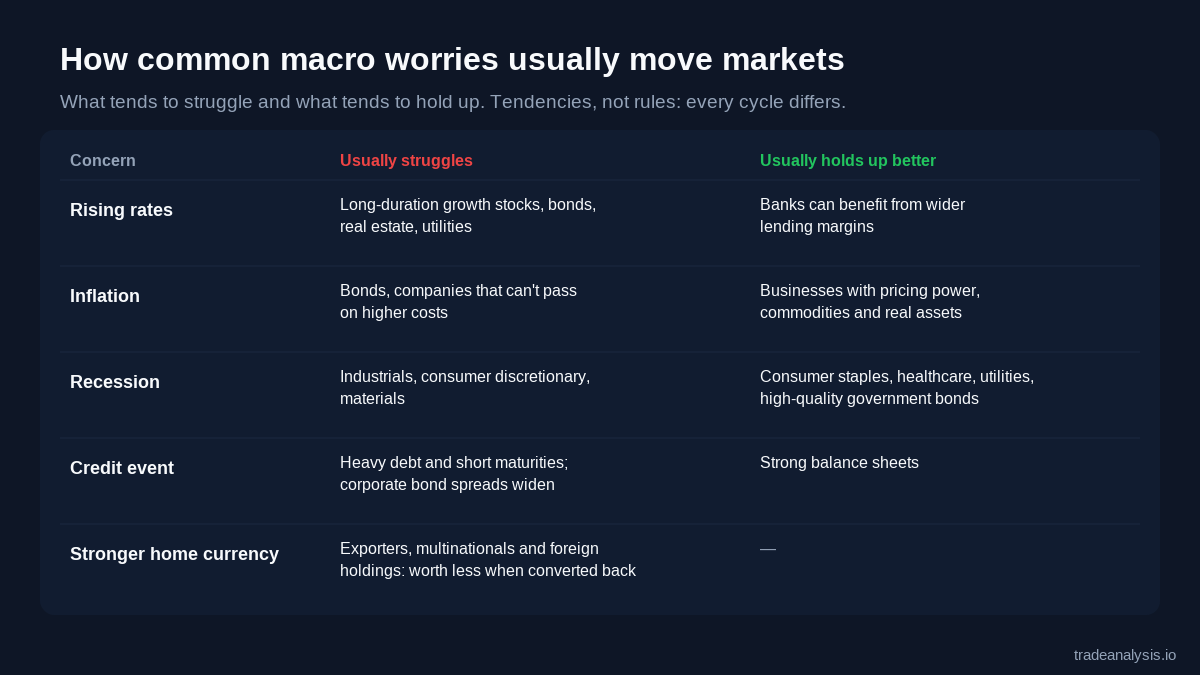
How common macro concerns move markets
Rising interest rates
Higher rates raise the discount rate investors apply to future earnings, so companies whose value lies far in the future (long-duration growth stocks) tend to be hit hardest. Bonds fall as yields rise. Banks can benefit from wider lending margins, while rate-sensitive sectors like real estate and utilities often struggle. The DCF calculator shows the mechanism directly: raise the discount rate and watch intrinsic value fall.
Inflation
Inflation erodes the value of fixed payments, which hurts bonds, and it squeezes companies that can't pass on higher costs. Businesses with pricing power, and real assets such as commodities, have historically held up better. Persistent inflation also tends to bring higher rates, so the two concerns often travel together.
Slowing growth or recession
Cyclical sectors (industrials, consumer discretionary, materials) usually suffer most when demand falls. Defensive sectors (consumer staples, healthcare, utilities) tend to hold up better because people keep buying their products. High-quality government bonds often rise as investors look for safety and rate cuts are priced in.
A credit event
When lenders get nervous, companies with heavy debt and short maturities are most exposed, and the spreads on corporate bonds widen. Strong balance sheets matter most. The AI stock screener includes balance sheet quality as one of its four criteria.
Currency moves
A stronger home currency reduces the value of foreign earnings and foreign holdings when converted back. Exporters and multinationals feel it in their results; investors holding foreign assets feel it in their returns.
The indicators worth knowing
- Central bank decisions and guidance: the direct driver of short-term rates.
- Inflation (CPI and similar): shapes rate expectations.
- Employment data: a read on the strength of the economy.
- Purchasing managers' indices (PMIs): an early read on business activity.
- Bond yields and the yield curve: what the bond market expects for growth and rates.
- Credit spreads: how much extra yield lenders demand from companies, a gauge of stress.
The report shows the live readings for the ones that matter most for the concern you name.
How to use it
- Name one concern at a time. The guidance is scoped to it, so separate runs for "rising rates" and "recession" give clearer answers than one vague worry.
- Use your real weights.
- Measure the exposure: the AI portfolio risk check quantifies rate sensitivity, beta, sector concentration and currency exposure.
- Rethink the mix if needed: the AI portfolio builder sets a target allocation from your goals.
- Check the companies: the AI competitor analysis looks at which companies in a sector are best placed.
Our guide portfolio diversification: what it actually means explains why a portfolio that looks diversified can still carry one large macro bet.
Where it fits in a research routine
Macro context is most useful before decisions, not after headlines. A practical rhythm:
- Name the one or two macro risks that would hurt your plans most.
- Run the report for each and note the indicators it highlights.
- Check the actual exposure with the AI portfolio risk check.
- Watch those indicators, not every headline, and revisit the report when they move.
- Adjust the allocation only when the evidence changes, using the AI portfolio builder as the target.
This keeps macro worries from turning into frequent, emotional trades.
What it doesn't do
- It doesn't predict the economy. It explains how a concern typically flows through, and the indicators that will show whether it is happening.
- It doesn't give single-stock trade signals. For trade levels on a chart, use the AI trading bots, such as the AI swing trading bot.
- It isn't advice. It is a research workflow; you decide what, if anything, to change.
The AI macro report is one of 14 AI workflows on TradeAnalysis; the methodology page explains how each one is built.
Frequently asked questions
- What does the AI macro report do?
- It explains how a macro concern you name, such as rising rates or inflation, typically flows through to markets, which sectors are most sensitive, which indicators to watch, and what positioning considerations apply to your holdings.
- What do I need to enter?
- The economic concern, and optionally your holdings with weights and a time horizon, for example: Portfolio: AAPL 40% MSFT 60%, Concern: rising rates, Horizon: 1 year. You can also just ask a question like "How would rate cuts affect gold?".
- Where does the data come from?
- FRED, the economic database of the Federal Reserve Bank of St. Louis: the Fed's rate, Treasury yields, inflation, unemployment, growth, credit spreads, the dollar, oil and the VIX. Each figure shows its own date.
- Why does the concern change the result?
- Because different macro risks hit different sectors. Rising rates, inflation, a recession and a credit event each produce a different read on the same portfolio.
- Which sectors are most sensitive to rising rates?
- Typically long-duration growth stocks, real estate and utilities, along with bonds. Banks can benefit from wider lending margins.
- Does it give buy or sell signals?
- No. It gives macro context and positioning considerations, not trade signals on a single symbol.
- Which plan includes it?
- Pro ($14.99 a month, 500 prompts) and Elite. One run uses one prompt.
- Can I ask about more than one concern?
- Run one concern at a time. The positioning guidance is scoped to the concern you name, so separate runs give clearer answers.
- How far ahead does it look?
- It uses the time horizon you give. A short horizon emphasises indicators to watch now; a longer one emphasises structural exposure.
- Which indicators matter most for inflation?
- Consumer price inflation readings, wage growth, central bank guidance and bond yields, especially inflation-linked yields that show what the market expects. The report highlights the ones most relevant to your concern.
- Is this useful for a small portfolio?
- Yes. Even two or three holdings can carry a large macro bet, for example on interest rates, and seeing it clearly is useful at any size.
- Does it work outside the US?
- The economic data is for the US, where rates and the dollar drive global markets. Holdings listed elsewhere are counted by region (for example emerging markets), and the report notes that your local central bank and inflation can differ.